Introduction
Lighting up an LED is often the first step in electronics. It sounds simple, but getting the resistor value right requires Ohm’s Law — one of the most fundamental concepts in electronics.
In this article, we’ll calculate the correct resistor value and build a working LED circuit on a breadboard.
What is Ohm’s Law?
Ohm’s Law states the relationship between voltage (V), current (I), and resistance (R):
V = I × R
To find the resistance needed, we rearrange it:
R = V / I
Calculating the Resistor Value
A typical red LED has these specifications:
- Forward voltage (Vf): 2.0V
- Recommended current (If): 10mA (0.01A)
With a 5V Arduino supply:
R = (5V - 2V) / 0.01A = 300Ω
The closest standard value is 330Ω, which is what we’ll use.
Circuit Diagram
Connect the components as follows:
- Arduino 5V pin → 330Ω resistor → LED anode (+) → LED cathode (−) → GND
Building on a Breadboard
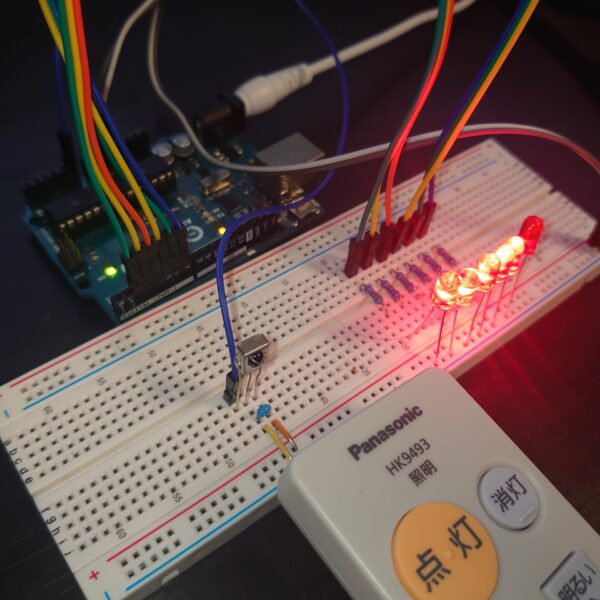
- Insert the 330Ω resistor into the breadboard
- Connect the LED anode to one end of the resistor
- Connect the LED cathode to the GND rail
- Connect the resistor’s other end to the Arduino 5V pin
Your LED should light up immediately — no code required for this basic circuit!
Summary
- Always use a current-limiting resistor with LEDs
- Calculate resistor value with: R = (Supply voltage − LED forward voltage) / desired current
- 330Ω is a safe choice for 5V Arduino + standard LED