Introduction
This article is based on public information available at the time of writing. Details may be updated as official reports are released.
“Will they actually make it back?”
Even NASA couldn’t answer that question with complete certainty — that was the reality of Artemis II.
A heat shield with known problems. The first deep-space crewed mission in 53 years. Six minutes of total communication blackout during re-entry. Any one of these could have ended the mission in failure.
And yet, they came home.
On April 10, 2026 (April 11 JST), NASA’s Artemis II mission successfully splashed down in the Pacific Ocean — the first crewed lunar flight since Apollo 17 in 1972.
This mission was not a simple success story. It flew with multiple unresolved engineering questions still open. The first crewed flight of SLS, deep-space radiation exposure, a heat shield redesign, plasma-induced communication blackout — each was being verified for the first time in actual flight.
This article covers both the triumph of the return and the technical challenges Artemis II was carrying, explained from an engineer’s perspective.
Artemis II faced criticism before launch for four main reasons:
- SLS cost overruns and delays — Called an “outdated rocket” whose budget ballooned to several times its original estimate
- Artemis I heat shield problem — Over 100 abnormal ablation events were detected during the uncrewed test, yet crewed flight proceeded
- Starship not yet flight-ready — The lunar lander for Artemis III has not yet reached operational status
- 53-year gap in deep-space crewed flight — All knowledge, training, and ground infrastructure had to be revived from the Apollo era
Flying with all these concerns unresolved made the “perfect” return all the more meaningful.
- Artemis II launched April 2 and splashed down April 10, 2026. All four crew returned safely after flying 406,771 km — a new record for the farthest humans have ever traveled from Earth
- Every major technical risk was cleared: SLS first crewed flight, deep-space radiation, heat shield redesign, communication blackout, and life support over 10 days
- This was a technology verification flight, not a Moon landing. It completes the final check before Artemis III’s crewed lunar landing
1. 🚀 What Is the Artemis Program? How It Differs from Apollo
Artemis is NASA’s human lunar exploration program, initiated in 2017. The differences from Apollo are fundamental.
| Apollo (1961–1972) | Artemis (2017–) | |
|---|---|---|
| Goal | Reach the Moon (Space Race) | Sustained lunar activity, deep-space exploration |
| Launch Vehicle | Saturn V | SLS (Space Launch System) |
| Spacecraft | Apollo Command Module | Orion Spacecraft |
| Agencies | NASA alone | NASA + ESA + JAXA + CSA |
| Final Objective | Land on the Moon and return | Build a lunar base, step toward Mars |
| Crew | Male astronauts only | First woman and person of color |
SLS produces 39 million Newtons of thrust, exceeding Saturn V’s 35 million. The Orion capsule has roughly 1.5 times the habitable volume of the Apollo Command Module and is designed for up to six crew members.
NASA’s heavy-lift rocket. Expendable design using four RS-25 engines (derived from the Space Shuttle) on the core stage, fueled by liquid hydrogen and liquid oxygen, with two solid rocket boosters. Payload capacity to low Earth orbit: 95–130 metric tons depending on configuration.
2. 👨🚀 The Four Crew Members — Historic Firsts
| Role | Name | Agency | Historic Record |
|---|---|---|---|
| Commander | Reid Wiseman | NASA | — |
| Pilot | Victor Glover | NASA | First person of color to travel beyond low Earth orbit |
| Mission Specialist 1 | Christina Koch | NASA | First woman to travel beyond low Earth orbit |
| Mission Specialist 2 | Jeremy Hansen | CSA (Canada) | First non-American to reach lunar space |
Compared to Apollo’s all-male, all-white crew, this lineup marks a genuine turning point in space history. Jeremy Hansen’s inclusion fulfills Canada’s negotiated condition for joining Artemis — sending a Canadian astronaut to the Moon.
During the lunar flyby, the crew photographed the Milky Way from deep space. With no atmosphere or light pollution, the image circulated widely on social media — a view impossible to see from Earth.
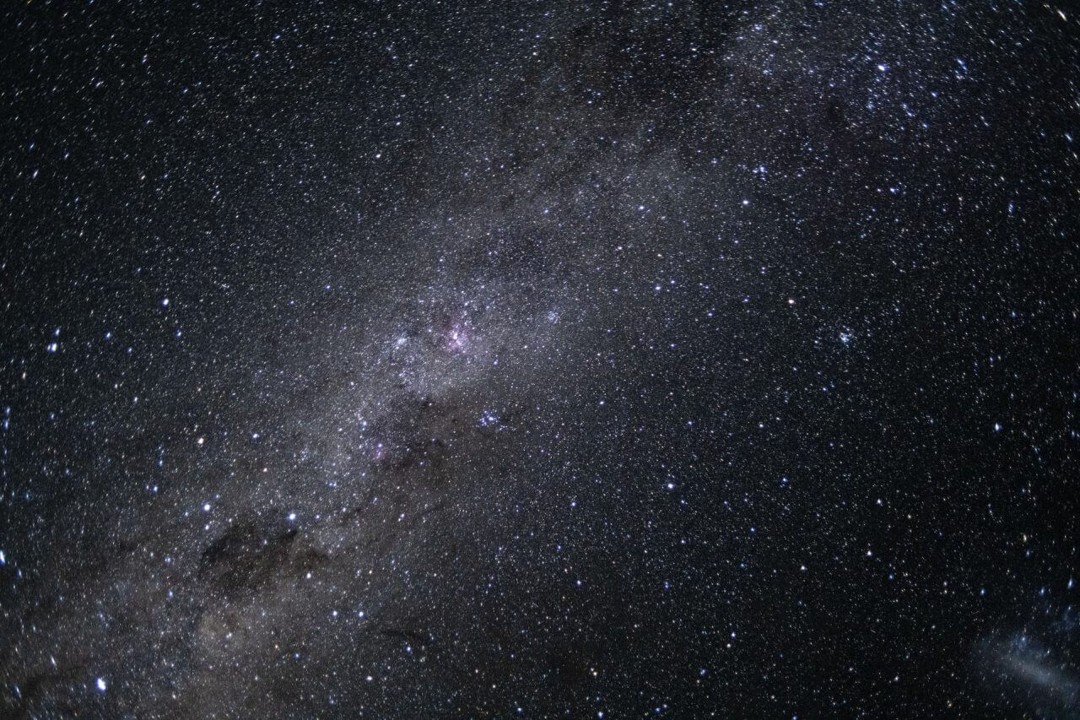
The Milky Way as captured by the crew from inside Orion. A view only possible in deep space, free from atmosphere and light pollution. (Artemis II / Credit: NASA)
3. 📅 Mission Timeline — 10 Days Step by Step
| Date/Time (JST) | Event |
|---|---|
| April 2, 07:35 | Launch from Kennedy Space Center (Launch Complex 39B) aboard SLS |
| April 6 | Lunar flyby along a Free Return Trajectory. Distance from Earth: 406,771 km — a new record for the farthest humans have ever traveled |
| April 11, 08:33 | European Service Module (ESM) separation |
| 08:37 | 18-second attitude control burn to orient the heat shield for re-entry |
| 08:52 | Re-entry begins at ~122 km altitude. Speed: ~39,700 km/h (~Mach 35) |
| ~08:53 | Blackout begins. Plasma envelops the capsule, cutting all communication for ~6 minutes |
| 09:03 | Drogue parachutes deployed at ~6,700 m altitude |
| 09:04 | Three main parachutes (~35 m diameter each) deployed at ~1,800 m, slowing to under 32 km/h |
| 09:07 | Splashdown in the Pacific Ocean ~130 km off San Diego |
Total distance traveled: ~1,117,760 km
Total mission duration: ~10 days
The crew surpassed the previous record for farthest crewed spaceflight (held by Apollo 13) at approximately 406,771 km — roughly 10 laps around Earth’s equator, or 40 round trips between Tokyo and New York.
After splashdown, USS John P. Murtha and NASA recovery teams were on station. Navy divers reached the capsule within about one hour, bringing all four crew members safely aboard.
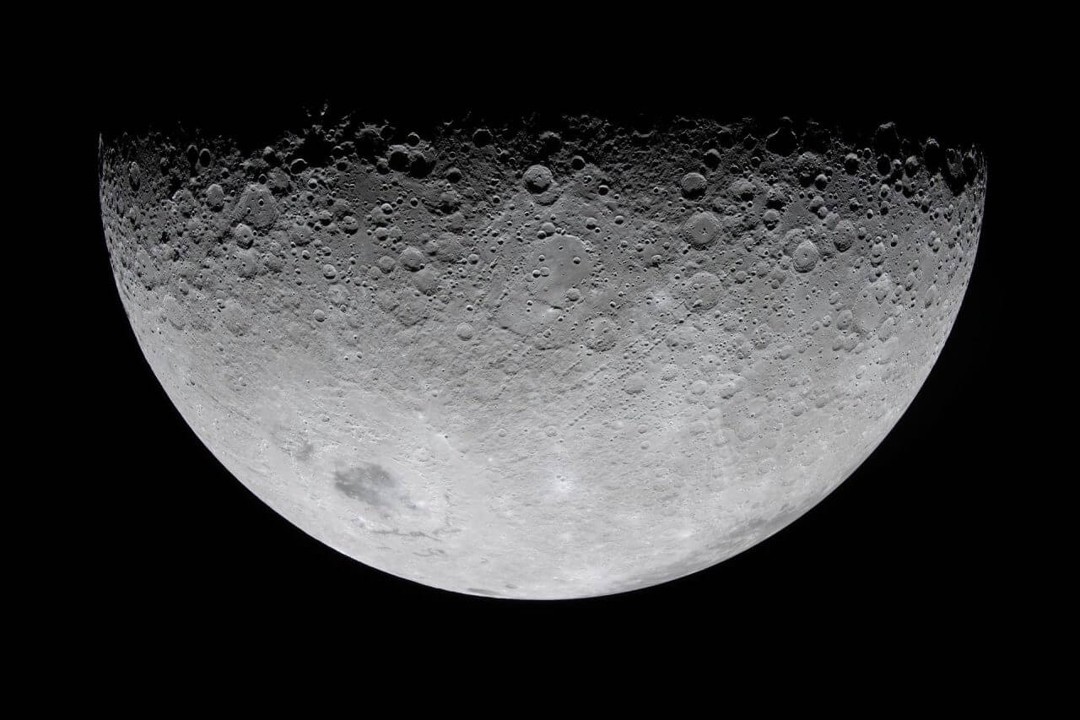
The Moon as seen through Orion’s window. Four people saw this view with their own eyes for the first time in 53 years. (Artemis II / Credit: NASA)
4. 🔧 Why Was Artemis II Risky? Five Technical Challenges
As the first crewed deep-space mission in over five decades, Artemis II faced risks that ISS missions don’t. Here are the five key engineering challenges.
Risk ① First Crewed Flight of SLS
SLS flew once before on Artemis I — but that was uncrewed. Artemis II was the first time humans rode SLS. Just as the first crewed Saturn V flight (Apollo 8) involved significant debate, a new heavy-lift rocket’s debut crewed flight is one of the highest-risk phases in spaceflight.
The core stage uses four RS-25 engines from the Space Shuttle program. Booster separation timing, upper stage RL-10 ignition reliability — these behaviors can’t be fully verified without humans on board. All of them were validated on this flight.
Risk ② Deep-Space Radiation
The ISS orbits within Earth’s protective magnetosphere at ~400 km altitude. Orion, traveling to the Moon and back, passes through the Van Allen belts and exits the magnetosphere entirely.
ISS astronauts receive roughly 0.5–1 mSv per day depending on conditions. In deep space, with almost no shielding from solar flares or galactic cosmic rays, exposure can surge dramatically. Artemis I carried dosimeters to collect baseline data; actual crew exposure was a key measurement on this crewed mission.
Orion uses hydrogen-rich materials like polyethylene in its walls. Crew shelter protocols during solar storm events are established. Crew wore AstroRad radiation shielding vests. During Van Allen belt traversal, procedures moved crew to the most-shielded areas of the capsule. Fundamentally, however, the best protection is getting in and out quickly — which is why the mission was designed as a 10-day flight.
Risk ③ Heat Shield Redesign (Lofted Entry)
During Artemis I re-entry in 2022, over 100 locations on the heat shield showed unexpected ablation material loss. The root cause is complex — ablation behavior, char layer spallation, internal gas dynamics — with low porosity of the ablative material identified as a key factor.
During re-entry, gases generated inside the ablative material need to escape. If porosity is too low, pressure builds internally and chunks of the outer layer are blown off.
ISS re-entry velocity: ~7.7 km/s. Lunar return velocity: ~10.6 km/s. Kinetic energy scales as:
E_k = \frac{1}{2}mv^2
That small velocity difference translates to roughly 1.9× the thermal load compared to ISS re-entry — a genuinely different category of stress on the heat shield.
NASA’s fix: change the re-entry trajectory. Instead of the originally planned skip entry (touching the upper atmosphere, bouncing, then re-entering in two stages), they switched to lofted entry — a steeper, single-pass trajectory.
| Skip Entry (original) | Lofted Entry (used) | |
|---|---|---|
| Entry angle | Shallow (~5–7°) | Steep (~17°) |
| Heating duration | Long (two stages) | Short (one pass) |
| Internal gas pressure buildup | More likely | Less likely |
| Landing accuracy | High | Somewhat lower |
The steep angle causes the outer surface to char quickly, creating a permeable layer that prevents internal pressure buildup — similar to flash-searing the outside of a piece of food to prevent it from bursting from internal steam.
Risk ④ Communication Blackout
Two communication challenges arise in deep space that don’t exist for ISS missions:
1. Propagation delay and bandwidth constraints
Earth–Moon distance reaches up to ~400,000 km. At the speed of light, that’s ~1.3 seconds one-way. Real-time emergency communication is impractical; crew autonomy is essential.
2. Re-entry blackout
During re-entry, the compressed air ahead of the spacecraft heats to thousands of degrees, ionizing into plasma. Plasma absorbs and reflects radio waves, cutting all communication for approximately 6 minutes. Ground controllers can only confirm the crew’s status after blackout clears.
| Parameter | Value |
|---|---|
| Re-entry velocity | ~39,700 km/h (~Mach 35) |
| Peak heat shield surface temperature | ~2,760–2,800°C |
| Blackout duration | ~6 minutes |
| Peak G-force | ~3–4 G (condition-dependent) |
NASA is investigating MHD (magnetohydrodynamic) control to thin the plasma layer using magnetic fields, but it’s not operational yet. For now, the only option is to wait out the 6 minutes.
Risk ⑤ Deep-Space Life Support Over 10 Days
Unlike the ISS, where astronauts have resupply options and rapid emergency return available, lunar missions spend days hundreds of thousands of kilometers from Earth. Emergency return would take days at minimum.
Orion managed CO₂ removal, temperature, humidity, and oxygen partial pressure entirely from its onboard systems — no resupply, no abort-to-ISS. The life support system ran continuously for 10 days and performed as designed.
Thermal management is also a challenge: far from the Sun, the side facing sunlight and the side in shadow experience extreme temperature differentials. Orion’s thermal control system operated continuously throughout the mission.
5. 🛸 Orion Spacecraft Specifications
| Parameter | Value |
|---|---|
| Launch mass | ~35,000 kg |
| Splashdown mass | ~9,300 kg (after fuel consumption) |
| Crew module diameter | ~5 m |
| Heat shield diameter | ~5 m (larger than Apollo’s 3.9 m) |
| Propulsion | European Service Module (ESM, built by ESA) |
| Maximum crew | 4 (6 under consideration for future missions) |
| Maximum lunar orbit duration | 21 days |
The European Service Module (ESM), built by ESA, contains solar panels, propellant, and life support systems, attached to the rear of the crew module. Only the crew module is recovered after splashdown.
Of the 35,000 kg at launch, most is propellant and expendable hardware. At splashdown, only the crew module remains — four humans plus the capsule structure. Spacecraft are essentially propellant tanks with a small payload at the top.
6. 🔭 What Comes Next — The Road to Artemis III
Artemis II was a technology verification flight, not a landing. Here’s what follows:
| Mission | Content | Timeline |
|---|---|---|
| Artemis I | Uncrewed test flight (Orion + SLS) | Completed November 2022 |
| Artemis II | Crewed lunar flyby (this mission) | Completed April 2026 |
| Artemis III | Crewed lunar landing (SpaceX Starship lander) | Planned 2028 |
| Artemis IV | Begin construction of lunar Gateway | 2030s |
For Artemis III, two crew members will transfer from Orion (remaining in lunar orbit) to a SpaceX Starship lander to descend to the surface. In one sentence: Orion is the taxi, Starship is the elevator and hotel.
The biggest unresolved issue for Artemis III lies with Starship:
- Not yet flight-qualified for crewed lunar landing — Starship continues test flights but hasn’t been certified for this mission
- Orbital refueling not yet demonstrated — Multiple propellant transfers in orbit are required; SpaceX is still developing this capability
- 2028 schedule realism — With these two points unresolved, meeting the schedule will be challenging
Even a “perfect” Artemis II doesn’t change the fact that Artemis III’s success depends largely on SpaceX’s development progress.
What Does Returning to the Moon Actually Change?
Lunar resource utilization
The lunar south pole likely contains significant water ice. Split water into hydrogen and oxygen, and you have rocket propellant. A Moon-based refueling depot would make Mars missions dramatically more feasible — no need to launch the full fuel load from Earth’s gravity well every time.
Space medicine and life sciences
Detailed data on deep-space radiation effects feeds back into medicine on Earth. Research on bone density loss, muscle atrophy, and vision changes in astronauts has real applications for aging-related diseases and long-term bedridden patient rehabilitation.
Technology spinoffs
Apollo’s technologies spread widely into civilian life — heat-resistant materials, miniaturized electronics, water purification, the precursors to cordless tools. Artemis will produce deep-space life support systems, high-precision autonomous navigation, and ultra-lightweight structural materials that will find their way into commercial applications.
✅ Summary
With Artemis II complete, every major technical verification for crewed deep-space missions has been checked off:
- ✅ SLS first crewed flight
- ✅ Deep-space radiation (crew exposure measured)
- ✅ Heat shield lofted entry (no anomalous ablation)
- ✅ Re-entry communication blackout (crew recovered safely)
- ✅ 10-day life support in deep space
The road to Artemis III — and humanity’s return to the lunar surface — is now clear on NASA’s side. The remaining question is whether Starship will be ready in time.